Introduction:
Capacity planning 101
It requires a careful balance between real-time employee availability, available dollars in the budget, and the demand for work from customers, partners, or other stakeholders. With so many moving parts (and demands), it can be tricky to keep everything in check.
To help you overcome these challenges, we’ve created this comprehensive capacity planning guide–bringing together insights and learnings from leading experts in this space.
Use it as a reference to help better understand how to manage employee capacity, allocate resources, and – most importantly – maximize profitability.
Explore the chapters in this guide by clicking the page links below.
3 key components of capacity planning with Amber Kemmis
3 steps to simplify your capacity planning with Hannah Taylor
Winning time-tracking framework with Marcel Petitpas
The same is true for a client project: If you don’t have enough resources to complete the project, it will not turn out as expected.
To make sure you have all the right ingredients when you need them – in this case, team members, skills, and tools – use a capacity planning process.
Capacity planning is the process of determining an organization’s capacity to meet short-term demand. For agencies, consultancies, and other client services firms, it essentially means determining if you have enough people available to deliver your client projects.
Capacity planning provides visibility over workloads and tasks at hand, so you always know if staff have enough bandwidth to deliver what you’ve committed to. It also enables you to keep things moving at a practical pace, avoid bottlenecks, and ensure team members don’t get burned out.
When done correctly, it should enable you to make genuinely meaningful, data-driven decisions about your staff and projects. Decisions such as:
Who is at capacity and who can take on more work?
Can I meet shifting deadlines or changes in scope without missing a beat?
Can I keep my people happy and prevent burnout while maintaining healthy team utilization and project pace?
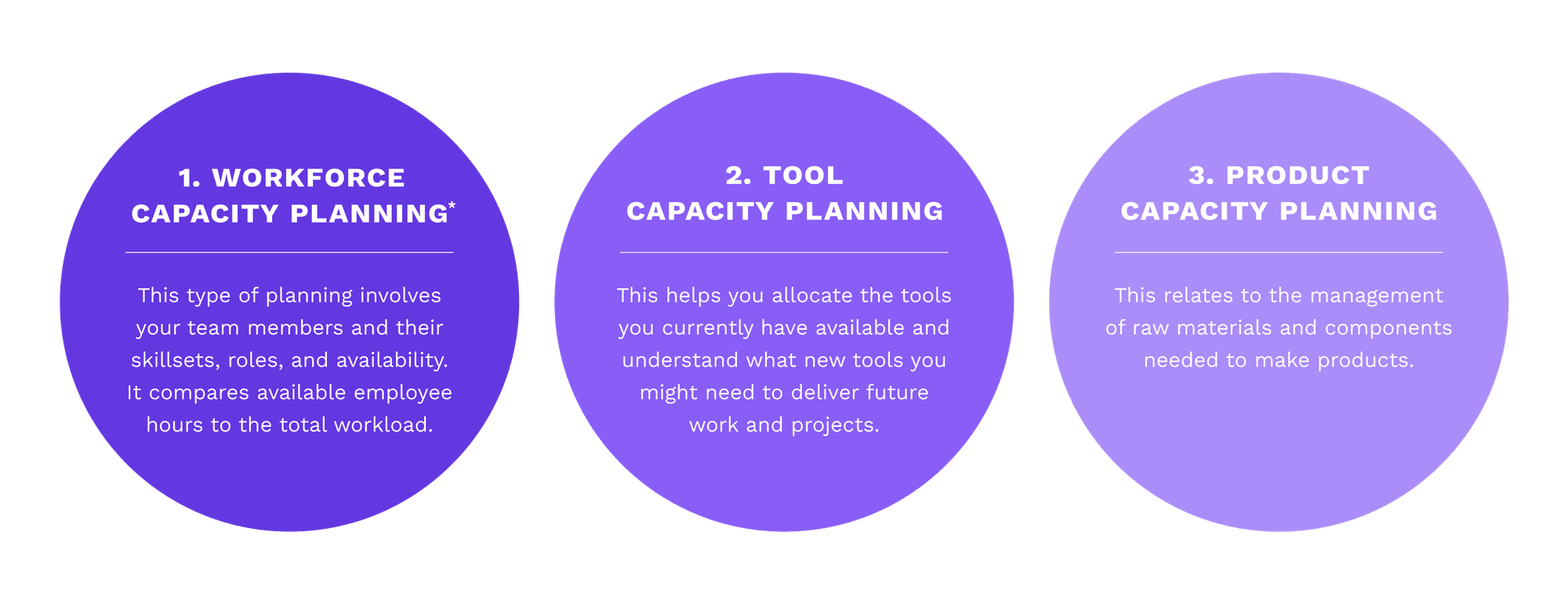
Depending on what type of business you are, you will probably have different needs for different areas of capacity planning.
*Of these, workforce capacity planning is the most relevant for client services organizations so it will be the primary focus of this guide.
Capacity planning isn’t a one-shoe-fits-all solution. There are different approaches and tactics you can implement in order to get results and improve your processes.
Here are the main capacity planning strategies and what industries and businesses they work best for:
Lag strategy is a strategy that focuses on actual demand and current orders. Rather than trying to forecast and make deliverables ahead of time, this approach only allocates resources when the need arises. This works best if you have a small business that is just getting started or if you know you only need to have a few resources set aside for new projects.
Lead strategy is the opposite of the lag strategy. Rather than waiting for a project to come in, lead strategy uses demand forecasting to predict what resources you'll need in the future and creates excess capacity in order to fulfill those resource requirements when needed. This works best for businesses that operate seasonally, like holiday-oriented businesses or ones that increase their sales during specific times of the year.
Match strategy is the best of both worlds between lag strategy and lead strategy. It focuses on strategic planning and carefully considers each project that comes up. You need to monitor your current demand, look at your upcoming projections, and constantly develop your strategy to shift when needed. It’s a flexible approach that works best for most businesses–especially client services.
Capacity planning offers many benefits that can significantly enhance the efficiency and effectiveness of your business’ operations. These include:
When projects go over budget or creep beyond the initial scope, it can add to your overhead costs. The same can happen when you need to buy more seats for your digital tools, have team members work overtime, and waste products through inefficient processes. When you have proper capacity planning strategies in place, you can reduce your costs and start improving your profitability.
Capacity planning provides an overview of your business processes and where there might be inefficiencies in your existing processes. When you evaluate resources, you can see if there are any areas where they aren’t being utilized correctly and where you can improve. These insights can drive real-time decision-making and improve your business management skills.
No one likes to be overworked or stressed out on the job. When you have poor planning, it leads to unhappy employees and higher turnover rates. With capacity planning, however, you can accurately track your team members’ time and availability. That helps you stop overloading your team members and can ensure that people with the right skill sets are being assigned to the right tasks and projects. Happier teams also tend to produce better work - quality is no longer jeopardized by having too much on their plate.
Capacity planning software is a specialized tool (or part of a suite of tools) designed to aid organizations in managing their resource allocation efficiently. Such software provides real-time insights, automation, and collaborative features that streamline the planning process.
By utilizing a tool like Teamwork.com, client services firms can enhance their capacity planning efforts through features that enable time tracking, workload planning, resource allocation, profitability monitoring, utilization reporting, and more in one place.